
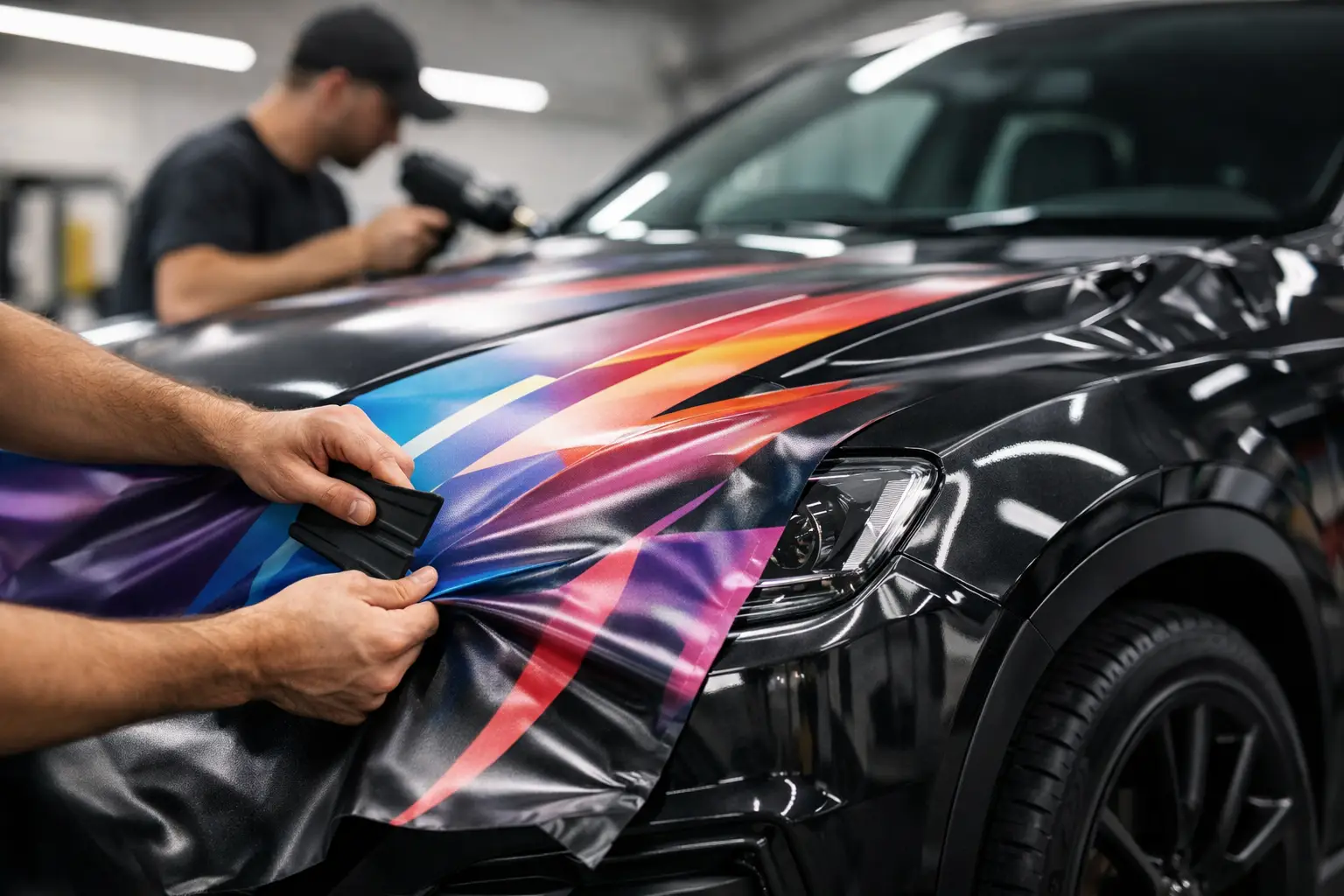
A business vehicle wrap has about three seconds to do its job.
That is the real design brief. Not “make it look cool.” Not “fit every detail about the company on the doors.” Just this: can someone see it in traffic, understand it fast, and remember the brand later?
That is where a lot of business vehicle wrap design goes wrong. The vehicle becomes a moving flyer, overloaded with text, tiny logos, and messages nobody can read past a red light. A wrap should not behave like a brochure. It should behave like branding in motion.
What business vehicle wrap design is really supposed to do
The best wraps do two things at once. They create instant recognition, and they make the business feel more credible before a customer ever clicks, calls, or walks in.
That matters even more for brands that operate in crowded urban areas, where people see dozens of vehicles every day. A wrapped van, pickup, or sedan is not just transportation. It is a rolling first impression. If the design feels cheap, cluttered, or generic, the business feels that way too.
On the other hand, a wrap that looks sharp, well-composed, and professionally installed sends a very different signal. It says this company pays attention. It says the brand has standards. For premium businesses especially, design quality is not extra polish. It is part of the sales message.
Start with the vehicle, not the artwork
One of the biggest mistakes in business vehicle wrap design is treating every vehicle like a flat canvas. It is not. A van gives you broad side panels and height. A sedan gives you less room and more curves. An SUV sits somewhere in between, often with shape lines, trim breaks, handles, and windows that can either help or hurt the composition.
Good wrap design starts by respecting the body shape. The door seams, fuel cap, wheel arches, and panel contours all affect where logos, text, and graphics should sit. If the key message lands across a seam or gets distorted over a curve, the design loses impact fast.
This is why experienced studios build around the vehicle rather than forcing a pre-made design onto it. What looks balanced on screen may feel awkward once it is stretched across real metal and glass.
Visibility beats detail every time
If someone cannot read the business name from a short distance, the wrap is underperforming.
That sounds obvious, but many businesses still prioritize stuffing in extra information instead of making the main identity bigger and clearer. Most drivers and pedestrians will only catch the company name, a service category, and maybe one contact point. That is enough if the design is smart.
Trying to include every service, every social platform, a full slogan, and a long list of benefits usually weakens the whole layout. Strong wraps edit aggressively. They keep what matters and remove what does not.
The best layouts feel simple, even when they are custom
Simplicity does not mean boring. It means controlled.
A high-performing wrap usually has a clear visual hierarchy. First, the eye catches the brand name or logo. Next, it sees what the business does. Then, if there is time, it notices a phone number, website, or another call to action. That order matters.
When everything is large, loud, and competing for attention, nothing wins. The design becomes noise.
This is where custom graphics can be powerful, but only if they support the message. Pattern work, stripes, fades, textures, or illustrative elements can make a wrap more memorable. They can also make it unreadable if overdone. The right balance depends on the type of business, the vehicle size, and the brand personality.
For a premium brand, restraint often creates a stronger impression than visual overload. Clean space, confident typography, and well-placed graphics can look more expensive than a wrap trying too hard to impress.
Color choices shape how the brand feels
Color is not just decoration in business vehicle wrap design. It affects readability, recall, and perceived quality.
High contrast tends to perform best for visibility. Dark text on a light background, or light text on a dark base, gives people a better chance of reading the message quickly. If the brand palette is subtle or tone-on-tone, it may look sophisticated up close but disappear on the road.
That does not mean every wrap should use loud colors. It depends on the brand. A luxury service may benefit from a darker, cleaner palette with selective highlights. A more energetic or mass-market business might need brighter tones and stronger contrast. The point is to design for real-world viewing, not just showroom lighting or digital mockups.
In hot, sunny climates, color decisions also affect how the finish presents over time. Certain tones show dirt, swirl marks, or edge contamination more easily. Matte and satin finishes can look stunning, but they require the right expectations and maintenance habits. Gloss can appear more familiar and reflective, while textured or metallic finishes add visual drama when used with intention.
Typography is where many wraps lose the plot
Fonts that look stylish on a laptop often fail badly on a vehicle.
The best wrap typography is clear, bold, and easy to read in motion. That usually means avoiding thin strokes, overly decorative letterforms, and cramped spacing. It also means giving text enough breathing room so it does not feel squeezed between body lines or packed against graphics.
Case choice matters too. All caps can work for short names or punchy service labels, but long lines in all caps are harder to scan. Mixed case often feels cleaner and more modern. Again, it depends on the brand.
A premium wrap should feel intentional, not accidental. If the typography looks like an afterthought, the entire vehicle will too.
Images can help, but they are not always the answer
Some businesses assume a photo-based wrap automatically looks more impressive. Sometimes it does. Often it just creates clutter.
Photos, product shots, and busy background imagery can reduce clarity if they compete with the logo and message. They also tend to date faster than a cleaner graphic system. A wrap that relies on trendy effects may feel old much sooner than one built on strong fundamentals.
Illustration, abstract patterning, or shape-based branding often ages better. It also gives more control over how the wrap flows around the vehicle body.
For premium brands, the strongest move is often to create a design language rather than paste marketing materials onto the car.
Installation quality changes how the design is perceived
A beautiful layout can still look disappointing if the installation is weak.
Misaligned panels, lifted edges, poor trimming, bubbles, or graphics that break awkwardly around handles all make the brand look less polished. This is one reason design and installation should never be treated as separate worlds. A wrap is not successful when the artwork looks nice in a PDF. It is successful when the finished vehicle looks intentional from every angle.
That is especially true for businesses using wraps as a premium brand signal. People may not know the technical reasons a wrap looks better. They just know when it feels properly done.
Studios that understand both design and application can make smarter decisions early, before a layout runs into problems on the vehicle itself. That saves compromise later.
Why custom beats generic for serious brands
Template-based wraps can work for very basic needs, but they rarely create distinction.
If the goal is simply to add a logo and phone number, a generic layout might be enough. But for businesses that care about image, consistency, and long-term brand presence, custom design usually makes more sense. It allows the wrap to reflect the business instead of looking like another service vehicle in traffic.
That matters for companies trying to look established, modern, or premium. It also matters for owner-driven brands, where the vehicle is part of the customer experience.
At a studio like Project Unicorn, this is where design becomes more than decoration. The vehicle stops looking like ad space and starts looking like a branded statement with presence.
A good wrap should still make sense six months later
Trends move fast. Your business identity should not.
The smartest business vehicle wrap design feels current without depending too heavily on whatever is popular this month. A design that is too trend-led can become dated quickly, especially if the vehicle stays in service for years.
That does not mean playing it safe. It means building around lasting principles – clarity, proportion, readability, brand fit, and quality execution. Then, if you want to add personality through finish, graphic direction, or bold composition, you do it on top of a strong foundation.
That is how a wrap keeps working long after the novelty wears off.
If you are planning one, think less about filling space and more about creating presence. The best business wraps are not the ones that say the most. They are the ones people remember after the vehicle is already gone.